

Politics is NOT the Answer
How slow, steady, stealthy decline, demographic change and institutional failure are reshaping Britain’s future

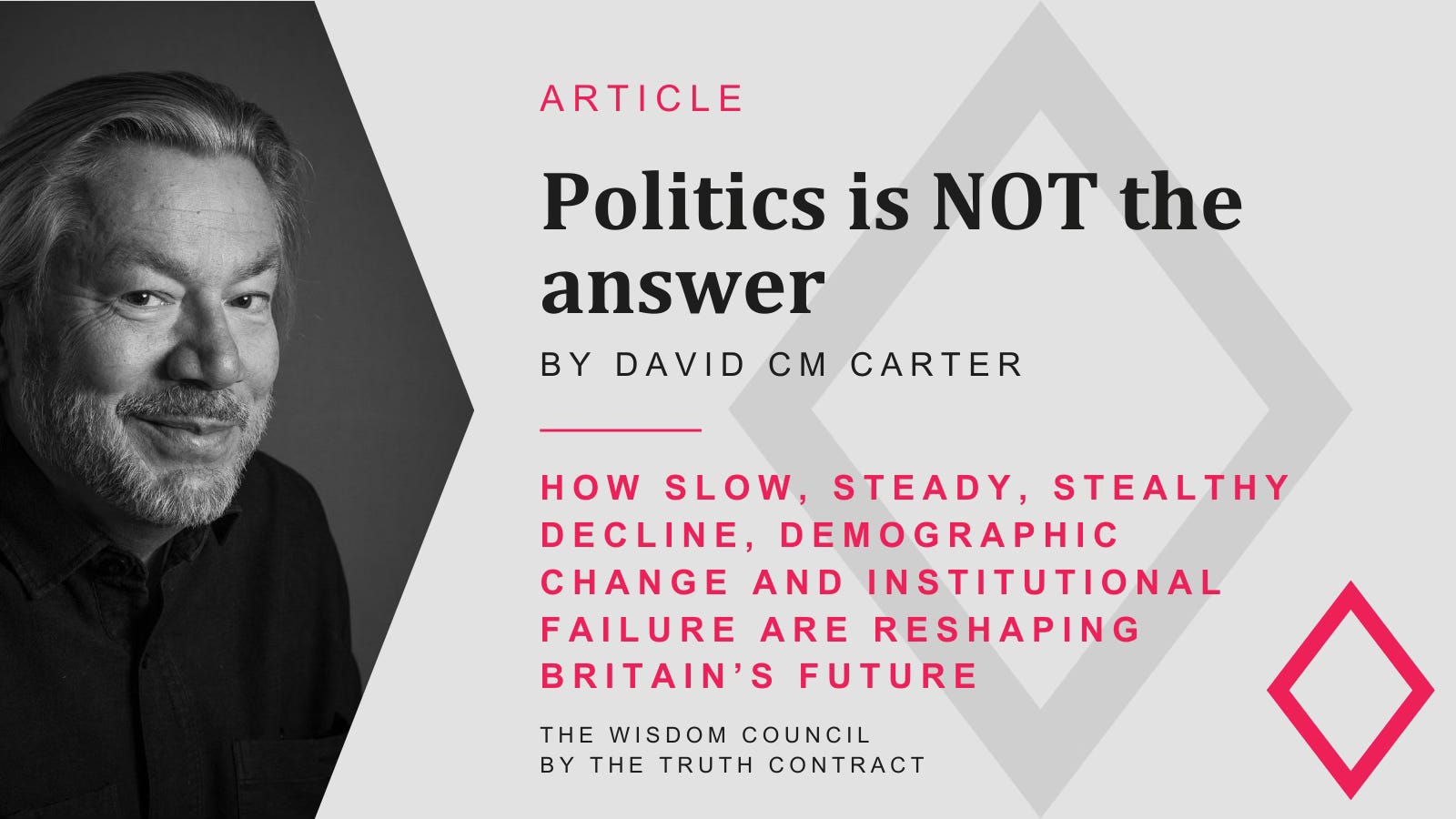
A personal essay on the structural decline of Britain – and what is required to reverse it.
The UK is in a mess.
Although not broken - yet - we are visibly deteriorating at an accelerating pace.
Politics is NOT the answer. So, what is?
Before explaining the answer, it is worth stepping back and looking carefully at what has actually happened to Britain over the past generation.
In this essay I will expand on three themes.
First, how a slow 2% decline each year, what I call the inflation effect, has quietly eroded the quality of life in Britain.
Second, how deeper structural forces, particularly demographics and long-term health trends, are shaping the country’s future far more than political or media headlines.
And third, why fixing Britain will require something very different from ‘business as usual’ politics with a new and different approach - built around expertise, execution, and true public mandate.
Only once we understand the scale and complexity of the problems can we begin to talk seriously about the solutions.
Before we dive into those 3 issues, a bit of background.
I am 67 years old. I was born in Britain. My parents were born in London. My four grandparents were born in Britain. My maternal grandmother’s parents arrived from Belgium after the First World War.
I was educated in Britain, at primary and secondary school in Surrey. I did not go to university. I built most of my career here as a serial entrepreneur. I live in Britain today, and I will die here.
I consider myself British. And English.
Over the course of my adult life, I have experienced many ups and downs.
A few years after my first child was born and we had bought our first family home in 1986, mortgage interest rates reached 17.1%. At one point, 65% of my salary went purely on mortgage payments. I experienced negative equity, meaning even selling the house would not clear the debt.
I went through an 18-year marriage that included nine pregnancies, resulting in two children. Later, I raised those children alone from the ages of seven and three. Today they have both gifted me a grandchild.
My career has included successes and failures. I have built several successful businesses and also seen a couple collapse. Despite the ups and downs – overall it’s been a great life.
However, the UK I was born into nearly seven decades ago has changed enormously, and not for the better.
Most of the systems we rely upon are visibly in serious decline. Unless something changes, and changes soon, the rapid decline will accelerate. And at some sooner-rather-than-later tipping point, it may become irreversible.
Like many people of my generation, I want to know that I did everything I reasonably could to leave this country in a better condition for my children and grandchildren. I assume most Britons feel the same. Perhaps that assumption is naïve. I hope it is not.
Because if people truly no longer care about what we leave behind, then any attempt to renew the country will be futile.
Nevertheless, I will continue the effort.
Through all of my life I have held onto a simple mantra:
Failure is not falling down. Failure is staying down.
That mantra now needs to be applied to saving Britain.
I am deeply worried about the state of our nation.
If not us, who? If not now, when?
Our initiative – the Great British Renewal Project (GBRP) – may or may not succeed. But if it fails, it will not be for lack of effort.
I have always believed that effort matters more than attainment.
Attitude determines altitude.
And I still believe that common sense can prevail. Not left versus right. Simply right versus wrong.
The Social Contract Illusion
Until about six years ago, I believed in the social contract.
The idea was simple: work hard, take responsibility, support your family and community, pay your taxes, and the system would take care of the fundamentals.
Education
Healthcare
Defence
Infrastructure
Economic stability
In other words, if citizens played their part, the institutions of the country would play theirs. That belief turned out to be an illusion. What I eventually realised, is that the system itself was not functioning as promised. The institutions that were supposed to steward the country were steadily making things worse.
What I Mean by “The Machine”
Throughout this essay I refer to something I call “the machine.”
By the machine I mean the network of institutions that effectively governs modern Britain regardless of elections.
This includes:
The permanent bureaucracy i.e. the civil service
Regulatory bodies
Quangos and arm’s-length agencies
Policy networks and advisory bodies
The media ecosystem
Supranational institutions and influences (UN, WHO, NATO, ECHR, WEF)
Together these actors shape policy, incentives and outcomes far more than elected politicians. Politics is theatre. Politicians appear on the stage. But the underlying system continues operating largely unchanged and unaccountable.
That system, the machine, is what has produced the steady decline we see today. And replacing politicians alone will not fix it. The system itself must change. The machine needs a factory reset. So, now let’s get into the 3 areas that this essay is really all about.
The Inflation Effect
One concept helps explain how decline can happen without most people immediately noticing.
I call it The Inflation Effect.
If something changes by only 2% per year, the shift often feels insignificant at first. We barely notice it.
Consumer prices are a familiar example.
If inflation runs at 2% annually, prices creep up slowly. We work a bit harder, cut a few expenses, maybe take extra hours at work. Life continues.
But over time the effect compounds.
After 31 years, £1,000 kept under a mattress loses half its value.
In other words, a seemingly small 2% annual change can result in a 50% loss of value over one generation.
This same compounding effect appears across many aspects of modern life.
Quality of life in Britain has followed a similar trajectory.
Slowly.
Steadily.
Stealthily.
The Inflation Effect in Everyday Life
When I was a child, if someone in my family was ill, my mother would call our local NHS GP. He would come to our house. Usually the same day.
Recently I visited my local GP surgery to request a non-urgent appointment.
The earliest available slot was four weeks and two days later.
No single policy caused that change overnight.
Instead, it reflects The Inflation Effect; small degradations accumulating over decades.
The same dynamic appears across many systems:
Healthcare access
Infrastructure quality
Institutional trust
Economic security
None of these collapsed suddenly. They simply declined a little each year. And after a generation, the difference is unmistakable.
Whether this deterioration resulted from poor incentives, flawed ideology, or simple incompetence is ultimately secondary.
What matters now is how we reverse it.
Changing Economic Realities
I left school and home in 1977.
My first job was at Barclays Bank International on Northumberland Avenue in London. The work was repetitive and dull. But it paid the bills and gave me a good starting point. Because the economy at the time was tight, I also worked in a pub on Thursday, Friday and Saturday nights. Between the two jobs I managed to pay rent, furnish a small flat, and still have something resembling a social life. Looking back, it was a period of both hard work and some of the most enjoyable years of my life.
Today we may soon see something similar return.
As artificial intelligence begins replacing many well-paid professional roles, in law, accounting, marketing, medical diagnostics and other fields, economic structures will change rapidly.
The shift may happen far faster than the 2% annual decline we have been discussing.
Many people may again find themselves needing to rely on multiple income sources simply to maintain a stable standard of living.
Over the last six years I have spent a great deal of time studying why Britain’s quality of life appears to have fallen by roughly 50% over the past 31 years, and what might be required to reverse that trend over the next generation.
Politics, in its current form, cannot solve this problem.
If the institutions that created the decline are the same institutions tasked with fixing it, meaningful change is unlikely. New thinking will be required. And new people. Who exactly are the people we are trying to save Britain for?
The answer is simple. The people of Great Britain.
If we are serious about the future of this country, we have to begin with the people who live here and will be born here. That means looking carefully at demographics.
Demography is the statistical study of human populations. It looks at the size of a population, its age structure, fertility rates, mortality, migration, and how these factors change over time. In simple terms, demography describes who we are, how many of us there are, and what the population will look like in the future.
There is a saying I have come to appreciate more and more over the last few years.
Demographics Determines Destiny.
In other words, the structure of a population largely determines the economic, social and cultural future of a country.
One of the most striking things about modern political discussion is how rarely demographics are talked about openly. Yet the demographic trends shaping Britain and most of the developed world are clear and deeply significant.
Two forces are moving in opposite directions at the same time.
People are living longer, which means more citizens require healthcare and retirement support for a longer period of time.
At the same time, fewer babies are being born.
To maintain a stable population each woman needs to have 2.11 children. This is known as the replacement rate. Across most of the world this threshold is no longer being met. In roughly 90 percent of countries fertility has fallen well below replacement levels and continues to decline.
In the United Kingdom the total fertility rate is now below 1.5 children per woman. That number has been falling steadily for decades.
This trend has enormous implications for the economy.
A useful way to understand this is through something called the dependency ratio. This measures the number of working age people who pay taxes compared with those who have reached retirement age and require support.
When I was born, the United Kingdom had roughly six working age people for every retiree. Today the ratio is closer to three to one. Over the next generation it is projected to fall toward two to one.
A society in which two workers support one retiree faces a very different economic reality from one in which six workers supported one.
Unless productivity grows dramatically, the system becomes mathematically difficult to sustain.
If these trends continue, a significant portion of future population decline is already built into the system.
Our own modelling suggests that if the United Kingdom were to close its borders tonight and allow no new migration, the population would decline by roughly twenty five percent within eighteen years and by approximately fifty percent within forty-one years.
Some people might view that as desirable from an environmental perspective. However, the economic consequences would be profound.
In Britain the top one percent of taxpayers contribute about thirty percent of total tax revenue. The top ten percent contribute roughly sixty percent. If a significant portion of those taxpayers chose to leave the country, the remaining tax base would face a severe burden.
Even a gradual change could have major consequences. If just two percent of the top ten percent left the country each year for thirty-one years, public spending would need to fall by around fifty percent simply to maintain fiscal balance.
Demographics therefore involves much more than immigration. It involves fertility, age distribution, health, economic productivity and long-term population structure.
There is also another dimension that has become increasingly concerning. That is the impact of environmental and lifestyle factors on long term health.
Across the developed world we are beginning to see early signs that people may not only live shorter lives but also spend fewer of those years in good health. In the United Kingdom the Office for National Statistics has reported that life expectancy improvements have started to reverse and that the number of years spent in full health is declining.
If this pattern continues, demographic pressures will intensify even further.
The good news is that many of these trends are reversible. But they can only be addressed if we are willing to examine them honestly.
The 2061 Decision
To understand where Britain may be heading, we have been working with a specialist in UK demographics to examine three points in time.
The first point is 1961. This was two years after I was born and provides a useful historical baseline from a comprehensive census study.
The second point is 2024. This uses the most recent census data updated to reflect current conditions as closely as possible.
The third point is 2061. This allows us to look one hundred years beyond the original reference point and roughly one and a half generations beyond the most recent census.
When projecting forward to 2061, there are three broad scenarios to consider.
The first scenario assumes that current migration trends continue.
The second assumes that migration is dramatically reduced or effectively stopped.
The third assumes a managed approach in which migration policy is aligned with a long term national demographic strategy.
This framework reflects what demographers sometimes describe as a trilemma. A trilemma describes a situation in which three factors cannot all be achieved simultaneously. Only two can be pursued at the same time.
In demographic terms those three variables are:
Low fertility
Economic growth
Ethnic continuity
If a country wishes to maintain economic growth while fertility remains low, typically, it accepts significant immigration and demographic change. This is often referred to as the mass migration model.
If a country prioritises ethnic continuity while fertility remains low, economic growth tends to stagnate. Japan and South Korea illustrate this model.
The third possibility is to maintain both economic growth and cultural continuity by encouraging higher birth rates while managing migration carefully. This is sometimes described as the managed migration model.
Over the past three decades Britain has effectively followed the first path. Immigration levels have increased significantly even though public opinion has repeatedly expressed a preference for lower migration.
That observation is not a political judgement. It is simply a statement of fact.
At some point the country will need to decide which long-term path it wishes to follow.
That is why the question of Britain in 2061 matters. Once a national vision is agreed, many other policy decisions flow from it.
Our full demographic analysis will be published in early May 2026. However, the key point is simple.
Before we argue about policy details, we must first decide what kind of country we want to be in the future.
The Norway and Central African Republic Thought Experiment
To see how powerful demographics can be, consider a simple thought experiment.
Imagine that tomorrow every Norwegian moved to the Central African Republic, and every citizen of the Central African Republic moved to Norway. The populations of the two countries would effectively swap places overnight.
The geology of each country would remain exactly the same. Norway would still have its mountains, oil reserves and infrastructure. The Central African Republic would still have its own geography and natural resources.
But the populations would be completely different.
And over time the culture, economy and politics of each country would likely begin to change accordingly. Geography may shape opportunity, but demographics shapes how a society actually functions.
What makes this example particularly interesting is that the two countries currently have almost identical population sizes.
In 1961 the Central African Republic had about 1.7 million people and a fertility rate of 5.96 children per woman. By 2025 the population had grown to roughly 5.5 million, with fertility still around 5.8 children per woman.
Norway followed a very different path. In 1961 Norway had around 3.6 million people and a fertility rate of 2.91. By 2025 the population had reached about 5.6 million while fertility had fallen to around 1.44 children per woman.
If those two populations were suddenly exchanged, the landscapes of the two countries would remain unchanged. Yet over the course of a generation, it is reasonable to expect that their societies would begin to evolve in very different directions.
Demographics does not determine everything. But it shapes the culture, the economic behaviour and the political institutions that emerge within a society.
That is why the phrase “Demographics Determines Destiny” matters.
And it raises an obvious question for Britain. If population structure changes significantly over time, it is reasonable to expect that the culture, economy and politics of the country will change as well.
The Toxic Soup Problem
So far, we have looked at demographics primarily through fertility rates, population structure and economic sustainability. However demographic trends are influenced by more than birth rates and migration. Long term health plays an equally important role, and this is where the discussion becomes more concerning.
This is another demographic trend that receives even less public attention. That is the decline in reproductive capability itself.
Over the past few years, a number of researchers around the world have been studying changes in human reproductive health. One of the most widely cited findings is the decline in sperm counts. Between 1980 and 2011 global sperm counts fell by more than sixty percent. More recent estimates suggest that by 2026 the decline since 1980 may be between seventy and eighty percent. Similar patterns are beginning to appear in female reproductive health, including reduced egg viability and increasing fertility challenges.
These changes are too large to dismiss as statistical noise. They point to deeper environmental and lifestyle factors that are affecting human health across entire populations.
In 2025 a few colleagues and I began looking closely at the research behind these trends. We wanted to understand why such a dramatic decline had occurred over roughly the same thirty-one-year period that we have been discussing throughout this essay.
Our investigation eventually led to a large body of research linking reproductive decline to exposure to synthetic chemicals and environmental toxins. The findings were concerning enough that we produced a podcast and presentation summarising the evidence, which can be found at spermegggeddon.com together with the underlying research sources.
The conclusions we reached were straightforward. Across modern industrial societies people are exposed to a growing mixture of synthetic substances through food, water, air, household products, plastics, agricultural chemicals, pharmaceuticals and personal care products. Many of these substances interfere with hormonal systems and immune and reproductive processes. Individually they may not cause immediate illness. However long-term exposure gradually weakens health.
Once again, we see the same pattern that appeared earlier in the essay.
Small changes accumulating slowly over time.
The Inflation Effect applied to health.
None of these exposures (perhaps with one noticeable exception!) cause people to suddenly collapse. Instead, they can reduce health outcomes by small percentages each year. Over the course of a generation those small changes can compound into very significant effects.
If reproductive capability declines by just two percent per year for thirty-one years, the long-term outcome could easily be a reduction of around fifty percent in fertility and reproductive health. The same pattern can appear in chronic disease, metabolic health and overall life expectancy.
If these trends continue, demographic pressures will intensify further. Fewer healthy working age people will be available to support an ageing population that requires more medical care for longer periods of time.
The encouraging part of this story is that many of these factors are reversible. Research consistently shows that alternative materials and production methods exist for most toxic substances currently used in industrial and consumer products. Removing or reducing these exposures could improve long term public health significantly.
If Britain were able to reduce many of the environmental toxins identified in the SpermEggGeddon research, it is reasonable to expect that the next generation would experience improvements in fertility, metabolic health and overall wellbeing. Over time that could reduce the burden on the National Health Service and contribute to a healthier and more productive population and economy.
This issue therefore sits at the intersection of health, demographics and economic sustainability.
It is also another example of how gradual decline can occur without attracting attention.
Beyond Demographics: other areas where the inflation effect appears
Demographics and long-term health trends are only part of the picture. The same slow compounding decline can be seen across many other aspects of life in the United Kingdom.
The inflation effect appears repeatedly in areas that affect daily life and national capability. Each individual change may appear small. Taken together over several decades they amount to a significant deterioration in national performance.
What follows is not an exhaustive list, but it illustrates how widely the pattern appears.
Free Speech and Public Debate
Britain has historically valued the principle that open debate strengthens society. Even if we disagree with what someone says, we said we would defend their right to say it.
In recent years that principle appears to have disappeared. Increasingly people feel that expressing dissenting opinions carries professional or social risks. Financial services, social media platforms and public institutions have sometimes restricted individuals for expressing views that challenge prevailing narratives.
At the same time police resources are often drawn into monitoring speech related issues while more serious crimes such as violent offences, organised exploitation and retail theft continue to affect communities across the country.
A healthy democracy requires open discussion and confidence that disagreement will not be punished. Restoring that confidence is an important part of rebuilding public trust.
Energy Policy and National Capability
Energy policy provides another clear example of long-term strategic drift. Modern economies require energy that is reliable, abundant and affordable. Without it industry declines, infrastructure weakens and living standards fall.
In recent decades Britain has pursued an ambitious set of climate policies under the banner of Net Zero. While environmental responsibility is important, energy strategy must also consider economic resilience and national security.
A practical energy policy must deliver four things simultaneously.
Energy sovereignty
Energy security
Energy abundance
Energy affordability
Similar principles apply to other fundamental resources that sustain a modern society.
Food systems must provide reliable supply that is healthy and affordable.
Water systems must provide clean water that is secure and resilient.
Air quality must be protected so that long term health is not compromised.
These are basic foundations of national wellbeing.
All of the above areas are in disrepair and neglect.
Technocracy and Surveillance
Another trend visible across modern governance is the expansion of digital monitoring systems. Technologies such as digital identification systems, algorithmic decision making and central bank digital currencies are increasingly discussed as tools for administrative efficiency.
However, these technologies also raise questions about personal privacy, autonomy and democratic oversight. Many citizens feel that these systems are being introduced gradually without clear public consent.
A free society must consider carefully how much surveillance and automated decision making it is willing to accept.
Institutional Integrity and Regulatory Capture
Confidence in institutions also depends on the perception that regulatory bodies act independently in the public interest.
When regulators receive a large proportion of their funding from the industries they oversee, questions about independence naturally arise. For example, the Medicines and Healthcare Products Regulatory Agency receives a substantial portion (86%) of its funding from pharmaceutical companies whose products it regulates.
Concerns about regulatory capture extend beyond healthcare.
Property fraud cases, financial misconduct and bureaucratic opacity have all contributed to declining public trust.
Strengthening institutional accountability is therefore a critical part of national renewal.
Productivity, Industry and Infrastructure
Over the past several decades Britain has experienced a long period of slow but steady deindustrialisation. Manufacturing capacity has declined while energy costs have risen to some of the highest levels in the developed world.
High energy costs make it difficult for industries to remain competitive. As factories close or relocate abroad, the country loses skilled jobs and economic resilience.
At the same time infrastructure investment has often lagged behind need. Issues such as deteriorating roads, ageing water systems and limited energy capacity reflect decades of underinvestment combined with fragmented ownership structures.
Reversing this trend will require long term strategic planning and significant investment in productive capacity.
Civic Literacy and Education
A functioning democracy requires citizens who understand the systems that govern their lives. Economic literacy and awareness of institutional structures help people participate meaningfully in public debate.
Education should therefore equip young people with the tools needed to understand how economies function, how institutions operate and how policy decisions affect society.
Without that knowledge public discourse becomes vulnerable to misinformation and short-term political narratives.
Housing and Family Formation
Housing affordability also plays a crucial role in demographic sustainability. If younger generations cannot realistically afford homes, family formation becomes more difficult and fertility rates often decline further.
Encouraging housing supply that supports young families is therefore closely linked to the demographic challenges discussed earlier in this essay.
Security and National Resilience
Finally, there are broader questions of national security and resilience. Modern threats increasingly involve cyber disruption, infrastructure vulnerability and economic coercion rather than traditional military invasion.
Ensuring that digital systems, financial networks and energy infrastructure are resilient against external interference is therefore essential.
Across all of these areas the same pattern appears again and again.
Small declines accumulating gradually over time.
The Inflation Effect applied to national systems.
Recognising that pattern is the first step toward reversing it.
Many of the concerns described above are already being discussed widely by the public, particularly online, even if they rarely appear in mainstream media or in political debate.
A detailed list of these issues can be found in the STOP List in Appendix ONE of this essay. The list is not exhaustive, but it reflects many of the areas where citizens increasingly feel that harmful policies should at least be paused and properly examined.
Reversing Decline
Understanding the scale of Britain’s challenges is only the first step.
Diagnosis alone does not improve a country. The real question is whether decline can be reversed.
Our view is that it can.
Many of the problems described in this essay are not the result of unavoidable natural forces. They are the result of decisions, incentives and institutional structures that can be changed. In many cases the solution is surprisingly straightforward. It involves recognising harmful policies and simply stopping them.
If we gathered ten thousand ordinary British citizens in the Royal Albert Hall and presented the evidence around some of the issues discussed earlier, I suspect many of the decisions would be remarkably clear. Faced with credible evidence that certain policies or substances were damaging long term public health, most people would vote to pause or stop those practices until proper research had been completed.
That instinct reflects common sense.
People want systems that protect their families, their communities and their future.
So, if politics is NOT the answer? What is?
Restoring that common sense approach to governance is a central goal of the Great British Renewal Project, or GBRP.
The Great British Renewal Project
Many people now sense what few in positions of authority are prepared to say plainly:
Britain’s crisis is both ideological and operational – and the two have become inseparable.
We are governed by a political class that no longer articulates a compelling national vision, and by a permanent bureaucratic system that increasingly exercises real power without accountability for outcomes. Leadership has been replaced by managerialism. Direction by process. Responsibility by diffusion.
The result is not chaos, but something more corrosive: managed decline.
Britain still functions, but it is creaking at the seams. Core systems – energy, health, infrastructure, productivity, borders, demographics, public trust – deteriorate year on year, not because solutions are unavailable, but because the system is structurally incapable of coherent vision and decisive execution. Nationals polls back this up.
This is not simply a failure of intent. It is a failure of vision, leadership, and structure.
The Truth Contract (TTC) exists to confront that reality – and to do what the current system cannot.
Over the next two years, TTC will investigate the full body of serious expert work already in existence – from practitioners, operators, economists, technologists, and policy thinkers – and bring that work into the open. Experts will be scrutinised, challenged, and socialised through long-form public dialogue. Their proposals will be tested, debated, and voted on by citizens via the TTC App.
TTC will then do the hard work politics no longer does: curation.
Policies will be integrated into a coherent, financially joined-up national manifesto – not a wish list, but a programme that actually works. That manifesto will be voted on by the public before the next general election, securing democratic legitimacy in advance rather than as an afterthought.
Only then is it offered to political parties.
Any existing or new party may choose to adopt TTC Manifesto – transparently and in full – and go to the country on the basis that, if elected, they will appoint the Great British Renewal Project (GBRP) to deliver it.
GBRP is therefore not a consultancy, contractor, or bidder. It is the exclusive execution arm of the same sovereign process that curates the vision, the policies, and the public mandate.
GBRP is a time-bound, expert-led national turnaround capability, assembled in advance, mandated explicitly, and accountable for delivery. Its role is to execute what has already been designed, legitimised, and authorised by the public, not to reinterpret or renegotiate it.
The economic context is stark.
Across infrastructure, energy, health, productivity, and governance, failures of execution quietly destroy national value measured in the hundreds of billions of pounds over a parliamentary cycle. These losses are already being incurred – through delay, waste, underperformance, and institutional inertia.
By contrast, the cost of restoring serious leadership and execution capability is orders of magnitude smaller – in the order of a few hundred million pounds.
This is not a promise.
It is a statement of scale.
And it points to a reality that can no longer be avoided: the asymmetry is now so extreme that inaction itself has become the riskiest option.
This is a refusal. We are drawing a line in the sand.
A refusal to accept a system in which Whitehall and its satellite bodies – quangos, regulators, and arm’s-length agencies – consume and destroy national value measured in the hundreds of billions, while the cost of restoring serious leadership and execution capability would be in the order of a few hundred million pounds.
For those prepared to step forward, the opportunity is not single-dimensional.
There is a tri-factor return.
First, a serious and defensible economic opportunity – grounded not in speculation, but in correcting one of the most expensive execution failures in a modern state.
Second, the chance to play a direct role in restoring national competence, confidence, and direction – to help arrest decline and rebuild systems that actually work.
Third, the opportunity to contribute to something larger than Britain alone: to demonstrate that a mature democracy can renew itself without authoritarianism, collapse, or permanent emergency – and in doing so, offer a credible model for others to follow.
Britain has been a reference point before. It can be again.
The question now is not whether we continue on our current trajectory — but whether those with the means, perspective, and capability are prepared to step forward and take responsibility.
The cost of inaction is no longer abstract. It is already being paid.
The Great British Renewal Project exists to turn engagement into impact — and responsibility into results.
It is time to be Great Britain again.
If you are interested in getting involved – as an expert – policy writer – podcast guest – or anything else, please do get in touch.
As the saying goes “the only thing necessary for the triumph of evil is for good men to do nothing”.
If not you, who?
If not now, when?
Appendix One
Health
STOP: mRNA ‘vaccination’ in humans, animals and food
Halt the manufacture and deployment of mRNA-based vaccines, including COVID-19 and future applications, until long-term safety is fully understood.
STOP: Bovaer and biome-altering interventions
Prohibit interventions that alter natural digestion and assimilation in animals, plants, and humans.
STOP: Fluoride in water
End the practice of adding fluoride to public water supplies without clear research on the effects on public health.
STOP: Addictive chemical additives in processed foods
Ban the inclusion of chemical additives designed to create dependency in consumers.
STOP: Toxic synthetic chemicals in agriculture
Eliminate the use of toxic synthetic chemicals that contaminate soil, harming ecosystems and food chains.
Sovereignty
STOP: ‘Zero Liability’ for medical interventions
Hold manufacturers accountable for the safety of their products, ending blanket immunity.
STOP: Government health mandates
Uphold informed consent and bodily autonomy by ceasing coercive public health directives.
STOP: Medical Agency and Regulatory Board capture
Prevent regulatory agencies (e.g. MHRA) from being influenced or controlled by the industries they oversee.
STOP: Digital ID and pervasive surveillance
Cease intrusive monitoring of citizens through forced use of ‘Digital ID’, and all forms of technological surveillance and biometric tracking.
STOP: Unelected bodies determining UK government policies
Ensure UK policy-making remains independent of the influence of onshore and offshore organisations such as the WEF, UN, WHO, and ECHR.
STOP: Election Interference
End the undermining of free and fair elections through social media, discriminatory fundraising laws, and algorithmic bias by major tech platforms.
STOP: Government covert psychological behaviour modification & propaganda
End the use of covert strategies and psychological tactics to influence and manipulate public opinion and decision-making.
STOP: Government and globalist propaganda in education
Remove political and corporate agenda-driven content from curricula in educational institutions – and stop attacks on home-schooling.
Democratic Accountability
STOP: Censorship and punishment of free speech
Defend open debate and protect individuals from punitive actions (e.g. de-banking, de-platforming, de-licencing, shadow-banning) for challenging dominant narratives.
STOP: Biological men taking the place of a women in sports and competitions
Preserve fairness in women’s sports, women’s contests (e.g. Miss World) and the workplace by maintaining biological birth sex-based criteria.
STOP: Wasting taxpayer money
Cease funding government expenditure that is non-transparent and/or ideology-based, whether domestic or in the form of overseas aid.
STOP: UK involvement in overseas wars
Withdraw from NATO, repatriate UK troops, and focus on domestic defence capabilities.
STOP: Unfair taxes
Unfair tax policies continue to burden individuals and small businesses while large corporations often exploit loopholes to avoid paying their fair share.
Energy & Infrastructure
STOP: Geoengineering and weather modification
Ban the release of substances such as aluminium, strontium, barium and graphene oxide into the atmosphere and water systems for weather modification and other purposes.
STOP: Net-Zero and CO2 targets
Reassess the unrealistic and economically harmful net-zero carbon emissions policy and all associated subsidies and taxes.
The Truth Contract – not just more content, but a commitment.
You’re here because the surface story doesn’t hold.
You’re ready to question, contribute, and help shape a future worth showing up for.
This is the contract: Truth. Action. Together.
Add your voice to the conversation. This is how we grow the mandate for change.
I really approve of the work you have done and that you are stepping up to propose some solutions to do something about it. The elephant in the room for me is the money system.I read a lot about inflation but I think I missed any references to our current financial system. Apologies if I did. I know we are being moved into another system with its own dire ramifications but the debt based Ponzi scheme we are in, skewed as it is to the benefit of those who make the rules and their cronies has to be one of the major contributors to the shit we are in. Attempting to reform that tends to get you regime changed. I don't think I have any of the practical qualifications you are asking for currently but would like to be of use in the future.
A thoughtful, interesting and sobering analysis. Coincidentally, my own article on the declining quality of UK democracy was published overnight (by my time down under): https://brownstone.org/articles/is-the-uk-still-a-liberal-democracy/
It does seem to me that more people are starting to rebel against the extent to which their preferences are ignored by the blob. The first step to recovery is open and honest discussion. This essay and your project should contribute, I hope, to shifting the Overton window.
We are just beginning that journey in Australia.
That said, I also think you under-estimate the role of politics in course correction. What if we had US-style primaries for candidate selection in each constituency? Could the existing elite consensus survive that shock to the political system?