

When Intuition Becomes a Moral Compass
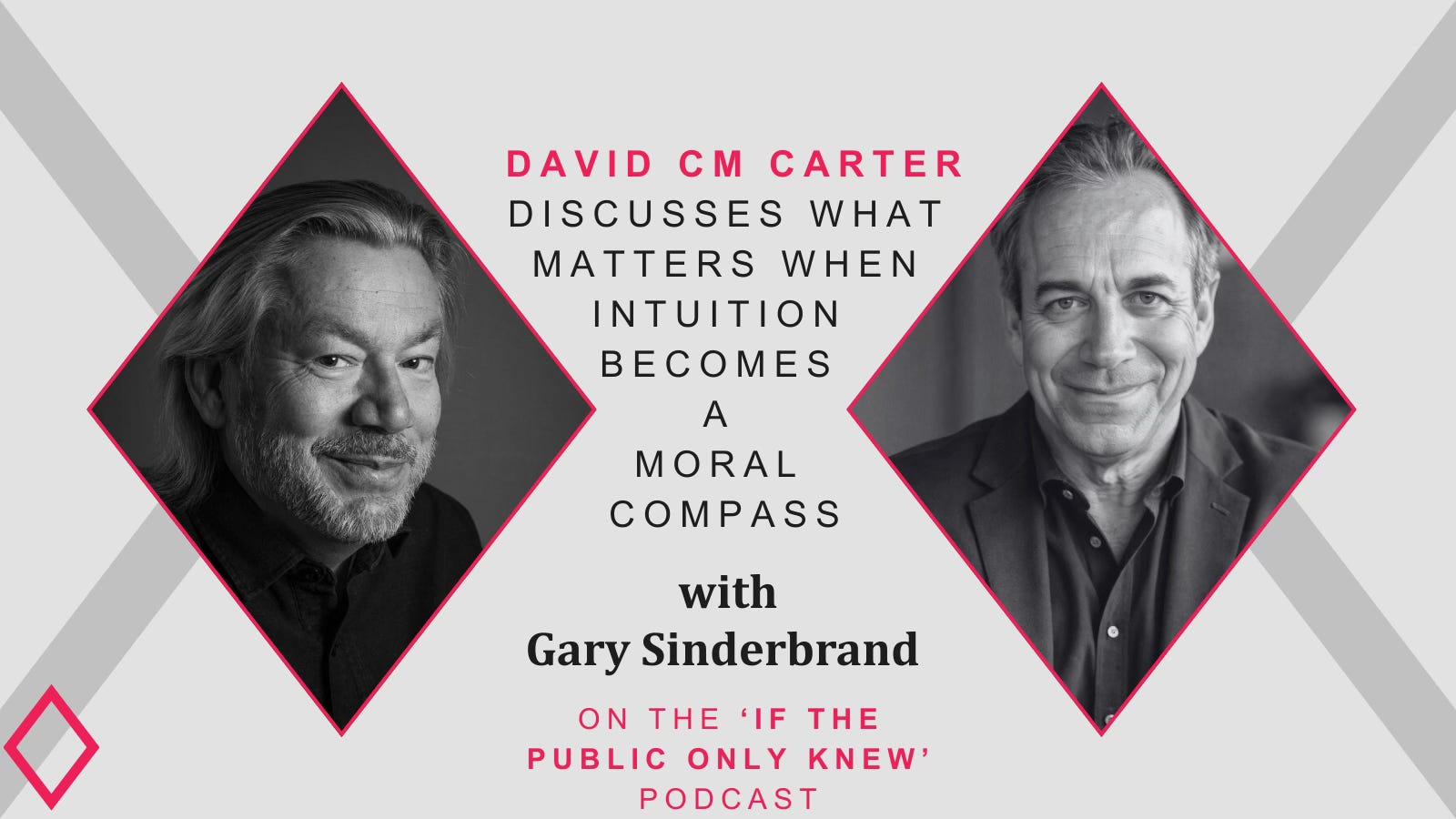
David CM Carter on the If The Public Only Knew podcast

There are conversations that provoke reaction.
And there are conversations that restore clarity.
David CM Carter’s recent appearance on If The Public Only Knew belongs firmly in the second category.
Hosted by Gary Sinderbrand, this was not a performance piece, nor a debate staged for clicks. It was a long-form, reflective conversation about a life spent watching patterns repeat – and learning when to trust what doesn’t show up on a spreadsheet.
For those encountering David’s work for the first time, his path is unconventional but coherent: from high finance and private equity in the late 1970s and ’80s, through decades of entrepreneurship and CEO mentoring, to the founding of The Truth Contract.
What connects these chapters is not ideology, but discernment – and a growing sense of responsibility that comes with seeing clearly.
Listen to the episode:
“You’re on the wrong side of the table”
Early in the episode, David recounts a moment that quietly changed the course of his life.
A mentor – after praising his performance – told him plainly:
“You’re on the wrong side of the table. Stop advising. Go and be an entrepreneur.”
It wasn’t a criticism. It was an invitation.
That decision took David out of consulting and into ownership – into risk, consequence, and accountability. It also sparked a lifelong fascination with what he later came to call the leadership X-factor: why two organisations, starting with the same resources and opportunities, diverge so radically over time.
The answer, he learned, rarely lives in the numbers.
Intuition isn’t mystical. It’s earned.
One of the most striking threads in this conversation is David’s insistence that intuition is neither vague nor irrational.
It is pattern recognition refined by experience.
After years assessing leaders across cultures, industries, and moments of pressure, David learned to sense coherence – or its absence – before words were finished. Not because he guessed, but because people are always transmitting signals. Most of us simply aren’t trained to listen.
As the conversation unfolds, this idea is handled with care. Intuition here is not positioned as an alternative to analysis, but as something analysis depends on.
“It always works,” David says. “The question is whether you listen.”
Effort still matters
A deceptively simple moment in the episode lands with unexpected force: David’s explanation of why handwritten letters still open doors in a digital world.
Not because they are nostalgic.
Because they cost something.
Time. Attention. Intent.
Effort, David suggests, is a signal – and in a frictionless environment, signals matter more than ever. When everything is easy, nothing carries weight. When something requires care, it’s felt.
This idea sits quietly beneath much of The Truth Contract’s work: depth over reach, substance over velocity.
From perception to responsibility
As the conversation deepens, David speaks candidly about the moment intuition turned into obligation.
During the Covid period, he began to notice growing discrepancies between official narratives and the evidence emerging from scientists, clinicians, and researchers across disciplines. Rather than reacting emotionally, he did what he had always done: he followed the patterns.
What emerged disturbed him – not just because of what it suggested, but because of how little space there was to question it openly.
The Truth Contract was not born from certainty. It was born from inquiry.
Not “this is the truth” – but “these things cannot all be true at once.”
Legacy thinking
One of the most human moments in the episode comes when David speaks about his grandchildren.
He doesn’t frame his work in terms of fear, nor in terms of winning arguments. He frames it as stewardship.
“I don’t want them to ask one day if I knew – and did nothing.”
This is not the language of outrage.
It’s the language of responsibility.
Ordinary people already sense it
A recurring theme in the conversation is that awareness is not confined to experts or elites.
Many people – working, parenting, caring – already sense that something doesn’t add up. What they often lack is time, access, and a place to evaluate information without being pushed toward panic or passivity.
This is where The Truth Contract positions itself differently.
Not as a megaphone.
But as a place to slow down, examine evidence, and restore the capacity for clear thought.
Why this conversation matters
You don’t need to agree with every conclusion in this episode for it to be worth your time.
Its value lies elsewhere.
In modelling how to question without collapsing into cynicism.
How to trust intuition without abandoning rigour.
How to speak about difficult things without losing composure.
In a world that increasingly rewards speed and certainty, this conversation offers something rarer: discernment.
🎧 Listen to the full episode:
David CM Carter: Waking Up the World with The Truth Contract
on If The Public Only Knew
We’d love to hear from you.
What stayed with you from this conversation?
Where in your own life have you learned to trust your discernment – quietly, against the grain?
If this resonated, consider liking, sharing, or restacking.
Not to amplify noise – but to strengthen the signal.
The Truth Contract – not just more content, but a commitment.
You’re here because the surface story doesn’t hold.
You’re ready to question, contribute, and help shape a future worth showing up for.
This is the contract: Truth. Action. Together.
Add your voice to the conversation. This is how we grow the mandate for change.
The importance of this theme - intuition in public life - can't be over-stated. Yet outside esoteric circles it's rarely talked about. Am with you in rectifying that.